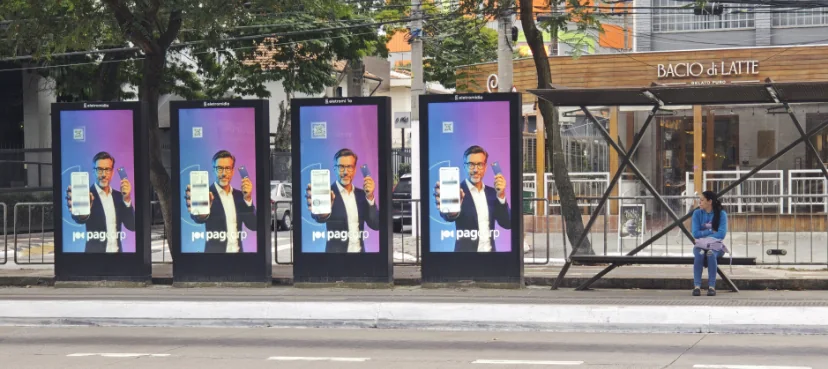

Understand why window-facing displays and true outdoor displays use different optical, thermal and enclosure priorities.
It's easy to assume that a "window display" is just an outdoor screen placed behind glass. But the design considerations are actually quite different — and if you spec the wrong type, you'll end up with a screen that looks terrible during the day.
The Core Problem: Reflection
When you put a screen behind storefront glass, the biggest enemy isn't sunlight — it's reflection. The glass acts like a mirror, reflecting everything on the street back at the viewer. A standard outdoor display with a glossy surface will look like a mirror during the day.
Window-facing displays solve this with:
- Anti-glare coating on the front surface (typically 2-5% haze)
- Brightness in the 1500-2500 nit range (not 3000+) — because the glass already blocks some ambient light, you don't need as much brightness
- Optimized viewing angle for people standing on the sidewalk at a 45-degree angle
Outdoor Displays Solve a Different Problem
A true outdoor display (totem, freestanding kiosk, building-mounted) faces direct sun. Its design priorities are:
- IP65 or higher waterproof rating — it's exposed to rain, snow, dust
- Active thermal management — fans or air conditioning to handle 40°C+ ambient
- Brightness 2500-3500 nits — to fight direct sunlight
- Vibration and wind resistance — it's freestanding or mounted on a facade
Why You Can't Just Use an Outdoor Screen in the Window
Putting a 3000-nit outdoor screen behind storefront glass causes three problems:
- It's over-bright — you're paying for 3000 nits when 2000 behind glass is plenty
- The glossy outdoor surface reflects the street, making the image look washed out during the day
- It generates too much heat, and the enclosed window cavity traps that heat, shortening lifespan
The Bottom Line
If the screen is behind storefront glass, use a dedicated window-facing display. If it's freestanding outside in the elements, use a true outdoor display. They look similar on the spec sheet, but the engineering is completely different.
Who this guide is for
Digital signage suppliers, outdoor advertising companies, system integrators, contractors and display distributors preparing a project brief.