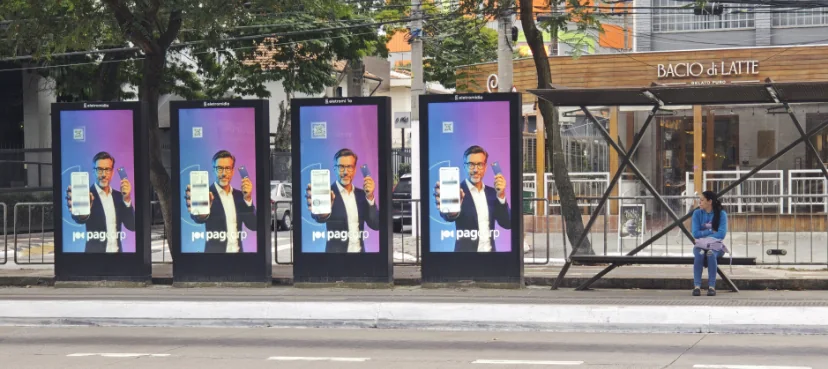

Match outdoor LCD brightness to direct sun, backlight, distance, content and heat, and read the nits number at finished-unit level.
Brightness is a site result, not a catalogue figure
An outdoor display that reads well on a shaded promenade can wash out in direct midday sun. The nits number on a spec sheet does not tell you how the finished machine performs at your site, because reflection, viewing distance, content, enclosure and cooling all change the result. Specify brightness from the site conditions first, then match a product to that requirement.
Read the nits number before comparing suppliers
Suppliers quote brightness at different points. Some quote the panel alone; others quote the finished display under a given backlight setting. Ask which figure you are being given, and whether it holds at normal operating temperature rather than only at a cool lab start.
For an outdoor project, the useful number is the sustained brightness of the finished enclosure, including how the front glass or cover, coating and heat build-up affect it. A panel figure that does not account for the enclosure is only a starting point.
Match output to the sunlight condition
The table below maps common outdoor conditions to a brightness class. Treat these as starting grades: confirm the final target against orientation, hours of exposure and the finished-unit measurement.
| Site condition | Brightness class to consider | What to check |
|---|---|---|
| Shaded or covered location, no direct sun | Around 2000 nits | Whether the display will ever sit in open sun at any hour; content mix between text and images |
| Mixed light, partial sun, orientation away from midday sun | Around 2500 nits | Reflection off the front cover, afternoon exposure, viewing distance |
| Direct midday sun, open plaza, south or west facing | Around 3000 nits | Finished-unit brightness at operating temperature, thermal headroom, anti-glare coating |
| Very high-brightness requirement | Confirm the 3000–3500 nits grade by model | Whether that grade belongs to the outdoor line or the high-brightness window-facing line, and cooling capacity |
The covered outdoor range includes 32", 43", 49", 55", 65", 75", 86" and 98" sizes; the high-brightness module range covers smaller integration sizes. Match the size family to the viewing distance before fixing the brightness grade.
Distance, content and operating hours change the target
Brightness is not the only readable-ness factor:
- Viewing distance. A small amount of extra brightness matters less than panel size and pixel pitch at long distance.
- Content. High-contrast graphics and large type remain legible at lower output than fine text or dark imagery.
- Operating hours. A unit running through a hot afternoon has to hold its brightness after the enclosure heats up; check the thermal design rather than the cold-start figure.
- Backlight control. Dynamic backlight can reduce power and heat for mixed content; review whether the route supports it.
Heat and IP rating follow the brightness choice
Higher output raises heat inside the enclosure. Outdoor machines therefore need cooling that keeps the panel and electronics within rated range, plus a front cover that keeps dust and water out. The covered outdoor line carries IP55 and IP65 grades; the right grade depends on exposure to rain, wash-down, dust and coastal or dusty conditions. Read the IP rating together with the thermal design, not as two separate decisions.
Common specification failures
- Choosing the brightest catalogue model for a shaded site, paying for heat and output the location does not need.
- Comparing panel nits from one supplier against finished-machine nits from another.
- Ignoring afternoon or west-facing exposure, when the screen will see its worst light.
- Specifying brightness without checking how the enclosure handles sustained heat through the day.
Who this guide is for
Outdoor advertising companies, system integrators, contractors and display distributors preparing outdoor LCD signage, totems or wall-mounted outdoor displays for sun-exposed locations.
FAQ
Is a 3000-nit screen always better outdoors?
No. A higher grade costs more, generates more heat and may be unnecessary in shade. Match the brightness class to the actual sun exposure, distance and content, and verify the finished-unit output rather than buying the largest number.
Does the panel nits equal the finished-machine nits?
Not necessarily. Ask whether the quoted figure is the panel alone or the finished enclosure at operating temperature. The enclosure front cover, coating and heat build-up can reduce what reaches the viewer.
What IP rating does an outdoor display need?
The covered outdoor line carries IP55 and IP65 grades. The choice depends on rain, dust, wash-down and environment; combine the rating with the thermal design for a full outdoor spec.
Does higher brightness affect heat and cooling?
Yes. Higher backlight output adds heat inside the enclosure, which is why sustained brightness and cooling have to be specified together. Check how the unit performs after it has been running in warmth, not only at a cold start.
What outdoor sizes are available?
The covered outdoor range spans 32" to 98" in the listed sizes; high-brightness modules cover smaller OEM integration sizes. Confirm the size and viewing distance with the supplier before selecting the brightness grade.
Related reading
Send the project inputs
Share the location orientation, viewing distance, screen size, estimated operating hours and destination climate. The sales team can confirm the brightness class and the relevant outdoor product route.